Climate and resilience
Take better care of buildings in a changing climate
ICI connects what is known about a building with verified information about the conditions around it. That helps owners prepare earlier, maintain systems more thoughtfully, plan improvements in the right order and keep useful records.
Climate action starts with understanding what is already there
Buildings use energy, need materials and rely on equipment that must be maintained and eventually replaced. Decisions are harder, and waste is more likely, when nobody knows what is installed, how old it is, what work has been done or which records are missing.
A Condition Profile gives a clearer starting point: what equipment and systems are present, what the visitor reported about it, what maintenance history is known, what remains uncertain, which local conditions place demands on those systems, and what is worth inspecting, documenting or discussing before money is committed.
How the pathway works
- Better building records. What is installed, how old it is, and what evidence stands behind each answer.
- Better maintenance timing. Service and replacement conversations happen with information rather than in an emergency.
- Opportunities to keep useful life. Equipment is less likely to be discarded only because its history went missing.
- Better retrofit sequencing. Heating, cooling, electrical capacity, ventilation, windows, insulation and air sealing affect one another.
- Less avoidable waste. Fewer duplicated investigations and fewer poorly ordered upgrades.
- Stronger climate preparation. Regional conditions turn into specific questions about this building.
Each step makes the next one easier to reach. None of them is guaranteed by having a record, and ICI does not measure whether they happened.
Preserving useful life, and using what is already there
Keep equipment that still has life
Good repair and replacement records help owners avoid throwing out equipment by mistake, discarding equipment only because its history is missing.
Support efficient operation
Knowing equipment type, age, service history and available documentation helps a qualified professional see where maintenance, controls or further investigation may be worthwhile.
Sequence improvements properly
Understanding the building before work starts can reduce duplicated investigations and poorly sequenced upgrades.
Keep retrofit evidence
Invoices, permits, commissioning records, equipment specifications and contractor observations help future owners and professionals understand what changed and whether more work is still required.
Prepare for the conditions around the building
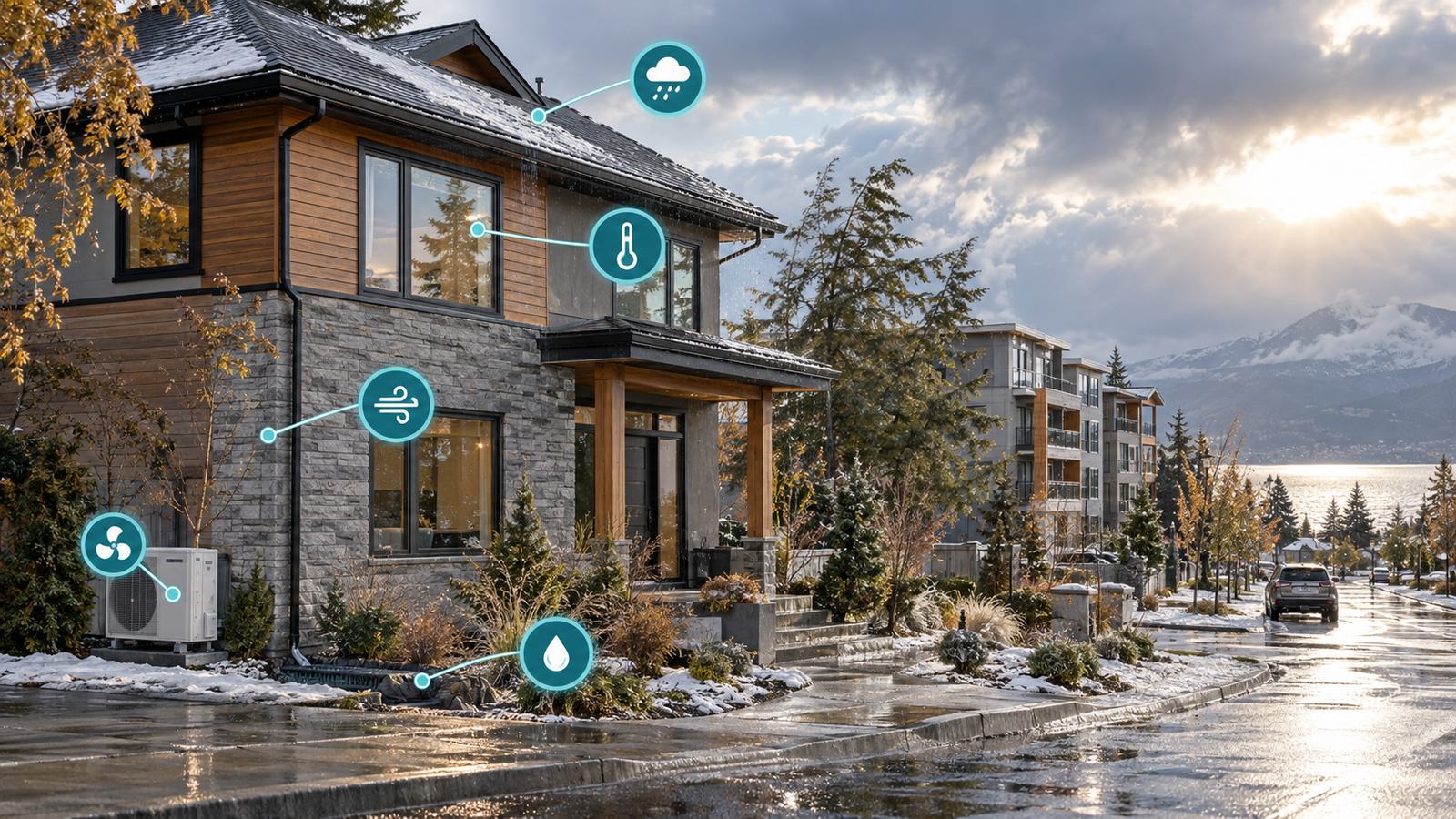
The Building Almanac turns regional evidence into practical building questions. Each one follows the same three parts: the regional context from a named authority, the systems that context implicates, and the evidence worth keeping before and after an event.
Heavy rain
Roof drains, gutters, downspouts, grading, foundation drainage, sump systems, backwater valves, and any previous water-entry records.
Extreme heat
Cooling readiness, ventilation, shading, filters, electrical capacity, and whether equipment information is to hand before peak demand.
Extreme cold
Heating service records, exposed piping, freeze protection, combustion-air pathways, and a plan for loss of heat or power.
Smoke and poor air quality
Filter type, replacement records, ventilation controls, and whether occupants know how the air systems should be operated.
Snow and wind
Drainage paths, safe equipment access, exterior components, and whether previous inspections or repairs are documented.
Long-run climate
Temperature and precipitation normals shape what equipment has to cope with across a year, and how hard it works in each season.
Regional context suggests what may deserve review. It never establishes that a particular building was affected, and it never changes a Condition Profile.
Three kinds of action, kept apart
Do now
Safe observations, gathering records, and routine preparation.
Find or confirm
Missing equipment details, service history and building features.
Plan next
Budgeting, qualified inspection or professional review.
ICI never tells an owner to perform dangerous electrical, fuel-fired, structural, roof-access or confined-space work.
A consistent evidence layer for programmes and portfolios
Consistent building information can help housing providers, municipalities, utilities, lenders, insurers and public programmes see where records are strong and where important information is missing. A governed Condition Profile distinguishes documented facts, owner-stated information, professional observations, missing information, regional context, recommended next evidence, and actions needing qualified review.
What this does and does not establish
ICI helps organise building records, evidence gaps, system context and practical next steps. It is not an energy audit, an engineering assessment, an inspection, an appraisal or a prediction that damage will occur.
It publishes no energy, emissions or savings figure, and it does not claim that keeping a record lowered emissions, avoided waste or extended the life of any equipment. Those outcomes are what better information makes easier to pursue and to measure. ICI has not measured them.
Regional weather and climate evidence describes an area. It does not determine the condition of an individual building and does not change the Condition Index.
Start with what is already there
A few minutes, and a dated Condition Profile you can keep.