Supporting record reported
You said a record exists. ICI has not received or verified it. “Furnace installed 2011, install invoice reported.”

How it works
A few minutes turns what you know today into a Condition Profile that shows what is supported, what is missing and what may deserve attention.
Answer what you know. Nothing at all is a valid answer to any of it.
How each answer is labelled, and how the suggestions are sorted.
You said a record exists. ICI has not received or verified it. “Furnace installed 2011, install invoice reported.”
You answered from your knowledge without reporting a supporting record. “Roof replaced around 2016.”
The information was not available. “Hot water tank, age unknown.” This never counts as poor condition.
Things you can safely look at, write down or tidy up yourself.
Missing details, like how old something is or when it was last serviced.
Jobs to budget for, or to have a qualified tradesperson look at.
We never suggest work involving electricity, gas or fuel, structure, roofs or tight spaces. And we never say something is going to fail.
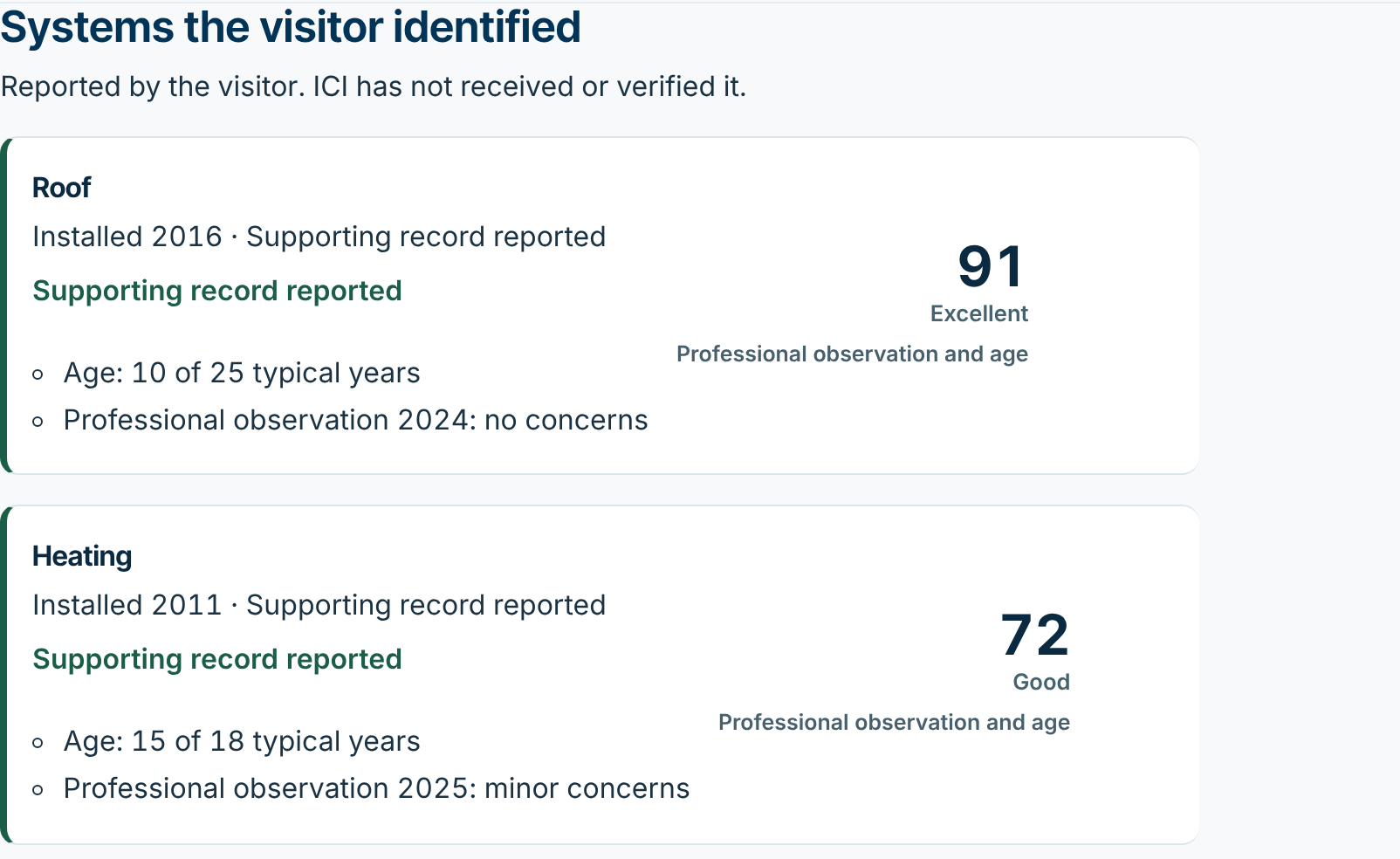
Asphalt shingle, replaced 2016 · professional inspection 2024 · Supporting record reported
Gas furnace, installed 2011 · professional inspection 2025 · Supporting record reported
No install year or inspection on file · No supporting record
ICI Score 79 · Good, beside evidence coverage of 65% (4 of 5 major systems documented). Method 2.4, pre-ratification.
Next useful step. Note the cooling unit’s install year from its rating plate.
Where the information can carry a finding, you get one. Where it cannot, the profile says so and names what would close the gap.
View a full sample · How results work
You can use ICI without an account. An optional account lets you save building profiles and return to them later. A saved building keeps its earlier versions, and you can update or delete it at any time.
A free ICI account can keep up to two saved buildings.
Find the gaps before a quote or a sale finds them for you.
Maintenance and replacement conversations start from the same record.
Model, age and evidence in one place before the visit.
A dated profile that outlives whoever remembered it.